


Success Stories

Morgan State Seeks to Strengthen Financial Wellness through the Use of Analytics

“I really do consider them a mentor institution in helping us further strengthen and hone the things that we’re doing. And we’ve been seeing really great results”
Dr. Kara Turner
Vice President for Enrollment Management and Student Success, MSU

Weber State focuses on data-driven decision-making processes
“The NISS team did a great job with the recommendations […] in just a short period of time we had recommendations that were so focused and carefully worded and easy to discuss in our leadership meetings.”
Jessica Oyer
Associate Provost for Enrollment Management & Student Success

North Carolina Central University: One of the NISS's First Diagnostic Clients
"This partnership has provided our institution with scalable solutions to address barriers to completion for our students. We are confident that the recommendations outlined in the Playbook will result in transformative change at NCCU through the enhancement of student success, retention and graduation rates."
Dr. Kimberly Phifer-McGhee
Associate Vice Chancellor for Academic Affairs

NISS Partners with the Detroit Chamber of Commerce
"To have the chance to work with NISS staff directly has been an outstanding and timely opportunity for us. Our in-depth conversations with members of their team have helped us envision key strategies to undertake in order to grow our proactive, systemic impact on student success."
Kristin Carey Li
Project Manager, Institutional Effectiveness

Cowley College Becomes the First Community College to Partner with the NISS
“Our team was very pleased with the collaborative activities and additional supports received from NISS staff throughout the process, especially the Institute’s willingness to customize the entire project for our institution. Ask any participant at Cowley College and they’ll be quick to recommend working with NISS staff if your campus is interested in improving the success of your students!”
Debbie Phelps
Executive Director of Institutional Research

Savannah State University is an Important Engine of Social Mobility for the Region
NISS provided a holistic and data informed assessment of my institution’s current student success strategies. It was a thorough campus-wide effort which supported meaningful dialogue and follow-up. The ‘Playbook’ recommendations gave my institution the opportunity to decide on priorities and the associated resources needed to execute them. Team NISS was always accessible, patient, willing, educating, and sincere about making a positive impact on our campus. This engagement also served as a reminder to everyone involved of the greater good and the importance of our collective work.”
Dr. Raymond Clarke
Vice President of Student Affairs

University of Missouri identifies key challenges that are institutional barriers to student success.
University of Missouri, Columbia, the flagship, land-grant institution located in Columbia, Missouri, worked with the NISS from May until September 2023 through the Diagnostic & Playbook service. While Mizzou has done great work in student success, they knew there was still more work to be done to help better serve their students. Mizzou was able to identify key challenges that are institutional barriers to their overall success rates and they co-constructed with NISS coaches a set of goals to overcome those barriers to help close their success gaps in retention and graduation rates. Moving forward, Mizzou will focus on areas of focus Mizzou improving internal and student-facing communications, streamlining advising processes and procedures, improving first-year support, and refining outcome data around courses to better support students academically.
The presentation and recommendations leave you with a determination to get to work and get started. It's a feeling of "let's get to work and let's start doing something quickly." [The NISS] presentation was absolutely the right tone and I am just so deeply grateful.
Dr. Latha Ramchand
Provost and Executive Vice Chancellor for Academic Affairs

First-Time Freshman Retention Rates
Average Percentage Point Increase Between Fall 2021 and Fall 2024 Retention Rates
The NISS’s first group of partner institutions—seven public universities in the University System of Georgia, including three HBCUs—launched the 5-month Diagnostic and Playbook process in 2021 and have had more than two years to implement their Playbook recommendations, most with formal coaching support from the NISS.
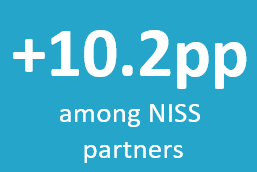
All seven institutions saw significant gains in retention rates over the last three years, with improvements ranging from 3.1 to 17.7 percentage points. The average three-year gain of 10.2 points realized by NISS partners was almost five times higher than the 2.1-point gain seen by public universities nationally.
First-time Freshman Retention Trends and Key Highlights
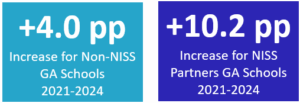
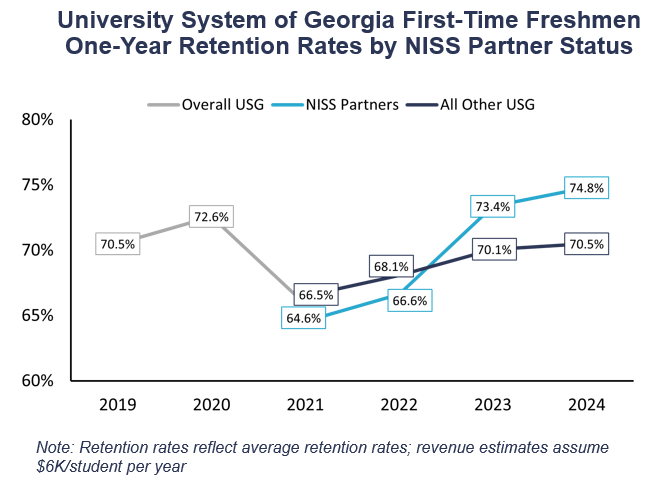
The NISS now has three years of outcome data for its initial cohort of partner institutions in Georgia. The first-time freshman retention gains realized by these partners have averaged 2.5 times the change for institutions in the USG that were not NISS partners. Retention rates have improved across the cohort each year. While partner retention rates began below their peers at 64.6%, rates surged by 10.2 percentage points to 74.8% in just three years.
Source: 2019-2020, IPEDS; 2021-2024, USG by the Numbers Retention Rate Reports

Accomplishments by Georgia Southern University
- – New Proactive Academic Interventions increased student engagement levels from 27% to 99%
- – Redesign of First-Year Experience Course allows students to develop and apply information literacy skills and to engage with their degree program focusing on career growth, campus resources, and the university community
- – Eagle Engage Program: Connects students intentionally to right-fit co-curricular programs, provides easy links to student/advisor resources, and allows programs to easily invite targeted students to specific events
“We intend to increase retention levels above pre-pandemic record rates by implementing NISS recommended retention initiatives such as adopting predictive analytics, introducing the Keep HOPE Alive program, and developing infrastructure to support coordinated, comprehensive student care. Georgia Southern’s retention goal for 2026, with the guidance and support of the NISS, is 81%!”
Kyle Marrero
President

Accomplishments by Fort Valley State University
- – Redesigned Enrollment 101: Equips students with the tools to navigate enrollment.
- – Targeted SAP Proactive Coaching: Targeted, data-informed support to help students at risk of losing eligibility for Federal Financial Aid hold on to their Pell Grants and Federal loans.
- – Advising Redesign: Is helping more students schedule advising appointments and register on time; Group Advising sessions at the Jones Student Center and library have shown a positive impact in retention.
- – Coordinated Communication Channels: Redesigning the use of email and text messages has played a pivotal role in fostering a more connected and informed student body.
- – 5.9% One-year increase in overall Fall enrollment
“The implementation of a comprehensive set of strategies has significantly contributed to the improvement of student retention and success within our academic community….By ensuring timely and relevant information reaches students, we have empowered them to make informed decisions about their academic journey, scheduling advising appointments, registering of classes in a timely manner, reducing uncertainty and enhancing their overall experience.”
President Paul Jones and Dr. Timothy Hatchett

The NISS Diagnostic and Playbook and service model is instrumental in moving the needle on student success.
The Diagnostic and Playbook process is a 5-month analysis that precedes the formal launch of implementation work. It engages dozens of campus stakeholders, ranging from faculty and student-success staff to the institution’s president and cabinet. NISS partners report that positive changes to their institution’s student-support systems begin during this initial diagnostic phase.
To learn more about our services, please visit our Diagnostic and Playbook services page.
“NISS provided a holistic and data informed assessment of my institution’s current student success strategies. It was a thorough campus-wide effort which supported meaningful dialogue and follow-up….and served as a reminder to everyone involved of the greater good and importance of our collective work.”
Dr. Raymond Clarke
Vice President of Student Affairs Savannah State University

Accomplishments by Kennesaw State University
- – Restructured ADVISING: Centralized management and reporting; Developed advisor dashboards to track engagement and initiatives; Adopted new advising technology
- – METRICS Dashboard: Resulted in 4% growth in student credit hour intensity
- – Early Alerts: 40% of faculty submitted mid-term grades for at least one course, totaling 38% of courses offered (2023)
- – uHoo Analytics: D2L-based faculty alert system being developed to facilitate student-success interventions during a semester
- – FLIGHT Program: First-year student engagement and identity program created under student affairs
- – BLOCK Scheduling: Redesign first-year experience; students select 2 blocks (15-16 credit hours) simplifying registration and ensuring a strong academic start
“Our partnership with the NISS has been a catalyst for change….[There are] six major student success initiatives in progress at KSU that are outcomes of our work with NISS.”
Ivan Pulinkala
Provost